








VietCALL International Convention (VietCALL2026)
Dear Colleagues,
The Vietnamese Association of Computer-Assisted Language Learning (VietCALL) is pleased to announce the 2nd VietCALL International Convention (VietCALL 2026), to be hosted by the University of Foreign Languages and International Studies, Hue University, Hue City, Vietnam, in late November 2026. Building on VietCALL’s strong engagement with its national and international community, VietCALL 2026 will serve as a forum for researchers, teacher educators, school leaders, practitioners, graduate students, and edtech partners to exchange evidence-based insights and classroom-ready practices on a priority that now shapes language teaching worldwide: AI literacy.
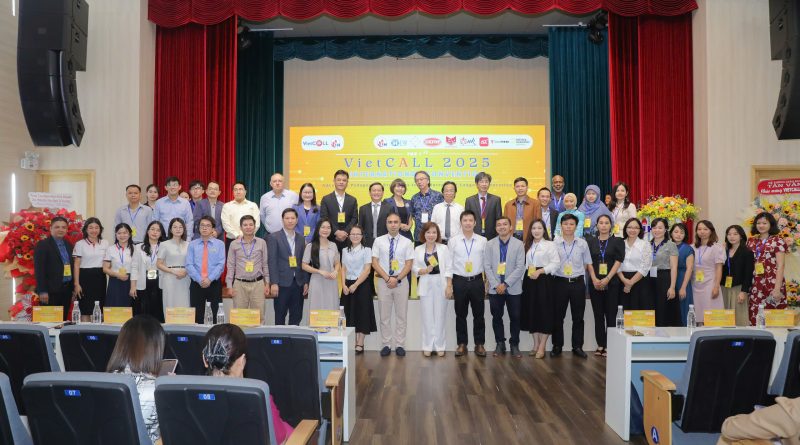
VietCALL would like to express our sincere appreciation to the Industrial University of Ho Chi Minh City (IUH) for its outstanding support and partnership in hosting and organizing VietCALL 2025. With IUH’s strong institutional leadership, professional coordination, and generous hospitality, VietCALL 2025 was delivered successfully and created a productive academic space for scholars and practitioners to share innovations in technology-enhanced language education. VietCALL recognizes IUH’s commitment to advancing research and professional development in English language education and Applied Linguistics, and we warmly value IUH’s contribution to strengthening VietCALL’s national and international networks.
Convention Theme Rationale
Generative AI and automated language technologies are rapidly reshaping how languages are taught, learned, and assessed. Teachers and learners face a dual challenge: to use AI effectively while also understanding limitations, risks, and ethical implications. In language education, AI can support feedback, translation, writing assistance, speaking practice, and assessment—but it can also amplify inequities, blur authorship boundaries, and introduce threats to validity in testing and evaluation. VietCALL 2026 responds to these realities by centering the convention on ethics, agency, and assessment—three pillars that shape whether AI becomes an empowering learning partner or a source of confusion, unfairness, and mistrust.
AI Literacy is more than tool operation. It is the capacity to critically evaluate AI outputs, interpret system constraints, make responsible decisions, and align AI use with pedagogical goals and professional standards. VietCALL 2026 emphasizes:
- Ethics: responsible and transparent AI use; privacy and data protection; consent; accountability; and appropriate boundaries for classroom and research practice.
- Agency: teacher and learner decision-making; autonomy; critical judgment; and the ability to choose when—and when not—to rely on AI.
- Assessment: fairness, validity, reliability, and integrity in an era where AI can both support learning and compromise evidence of learning.
Theme: Advancing Pedagogical Strategies for AI-Integrated Language Education
Sub-themes include but are not limited to:
- Responsible AI Use in Language Education: ethics guidelines, risk management, transparency, and stakeholder communication.
- Bias, Fairness, and Inclusion: language varieties and accents, cultural/linguistic bias, disability access, and equitable AI-supported feedback.
- AI Literacy Frameworks and Curriculum Design: learning outcomes, progression models, and integration into TESOL/Applied Linguistics curricula.
- Academic Integrity and Authorship: disclosure norms, citation/attribution practices, plagiarism policy updates, and governance of AI writing support.
- AI-Aware Language Assessment: assessment redesign, validity arguments, rubrics for AI-mediated tasks, and secure testing approaches.
- Teacher Professional Development for AI Literacy: competencies, training models, mentoring systems, and institutional capacity building.
- Learner Agency and Self-Regulated Learning with AI: metacognitive prompting, reflection protocols, and responsible use habits.
- Research Methods and Evaluation: experimental/quasi-experimental studies, mixed methods, learning analytics, instrument validation, and measurement of AI literacy.
- Languages & Linguistics
- Translation and Interpretation
- Language and Culture
- Cross-Cultural Communication
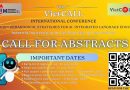
Important Dates
- Call for Papers:1st April 2026
- Abstract Submission:1st April 2026 – 30 June 2026
- Notification of Acceptance:10 – 15 July 2026
- Early Bird Registration: Until 30 August 2026
- Registration: 5 September 2026
- Full Paper Submission:10 September 2025
- PowerPoint Submission:10 October 2025
- Dates: 18th October 2025
Formats and Participation
VietCALL 2026 welcomes a range of scholarly and practice-oriented formats, such as:
- Research paper presentations
Practice-based demonstrations (classroom models, tools, materials)
- Symposia/panel discussions
- Workshops and teacher development sessions
- Posters (including work-in-progress and doctoral research)
Publication Opportunities
VietCALL 2026 will publish the full papers in the following journals/proceedings
- Tạp chí Khoa học Ngôn ngữ và Văn hóa – Trường Đại học Ngoại ngữ – Đại học Huế
- International Journal of AI in Language Education
- ICTE Conference proceedings
Note: The publication fee is not included in the Convention fee. The authors will pay the APC only when their papers are accepted for publication.
Who Should Attend?
VietCALL 2026 is designed for:
- Language teachers and teacher educators seeking practical AI literacy models
- Researchers investigating AI, CALL, assessment, and educational measurement
- School and university leaders shaping policy and institutional practice
- Graduate students developing thesis and dissertation projects in AI and language education
- Educational technology developers interested in responsible, pedagogy-aligned design
Call-for-abstracts theme paragraph (120–170 words)
The 2nd VietCALL International Conference (VietCALL 2026) invites educators, linguists, researchers, technologists, and policymakers to join a vibrant international forum exploring AI Literacy for Teachers and Learners: Ethics, Agency, and Assessment. As generative AI increasingly influences language teaching, learning, and evaluation, the field must move beyond tool adoption toward principled, evidence-based practice. VietCALL 2026 focuses on how teachers and learners can use AI responsibly, recognize limitations, and make informed decisions that protect learning quality and human judgment. We welcome proposals addressing responsible AI use, bias and fairness, academic integrity and authorship, and AI-aware testing and assessment design, alongside frameworks for developing and measuring AI literacy across contexts. VietCALL 2026 aims to strengthen dialogue between research and practice, promote equitable innovation, and support institutions in building trustworthy, transparent, and learner-centered approaches to AI-integrated language education.
Join VietCALL 2026
VietCALL 2026 invites the language education community to move beyond “tool talk” toward principled, evidence-based decision-making. Together, we will clarify what AI literacy should mean in language education, how it can be taught and assessed, and how institutions can protect fairness and integrity while empowering teachers and learners.
Submission Guidelines:
- Abstracts: Up to 170 words, including keywords.
- Full Papers: Between 6,000 and 8,000 words, following APA 7th edition formatting.
- Submission Portal: https://vietcall.edu.vn/submission
Contact information:
For further information, please visit our website or contact the conference organizers at
Email: lanhuongnckh@gmail.com (Ms. Huong)
Tel: (+84) 988049988 (Ms Huong)
WhatApps: (+84) 909850699 (Pham Ho)